|
|
 |
|
 |
 |
 |
History
of the Institute |
|
|
 |
In
the spring of 1975, Claudio Cipullo, Piero
Cerri and Massimo Corona each separately asked
Lama Thubten Yeshe to come to teach in Italy
during his second world tour; to each of them,
he agreed. Returning to Italy several months
later, they began working together to organize
the first meditation course with Lama Yeshe
and Lama Zopa Rinpoche in Italy. At that time
Piero, already a monk, was staying in the
entrance hall of a house sublet by a friend
of his. This became their office. It was a
bare, unfurnished room, with only a carpet
on the floor and a telephone. From this office,
they produced pamphlets and posters, pasting
them up around town to announce the upcoming
course.
This first course was held in a Roman Catholic
retreat center in Eupilio, from October 13
- 20, 1975 and was attended by about eighty
people. On October 19th, many of the participants
at the course met with the organizers to discuss
the possibility of establishing a center in
Italy. They requested and received permission
from Lama Yeshe to do so. Later that evening,
towards midnight, after most of the participants
had gone to their rooms, Peter Kedge, Lama
Yeshe’s secretary, came to call Massimo,
Piero and Claudio, saying, “Lama wants
you in his room immediately.” When they
entered his room Lama said, “I thought
of a name for the center which will be established
in Italy but, first of all, you have to tell
me whether you really want it as in that case
you will have to dedicate yourself one hundred
percent to the center. That means that you
will have to stop everything else that you
are doing, because I need a total commitment
from you.” The three promised their
full commitment and Lama asked them to choose
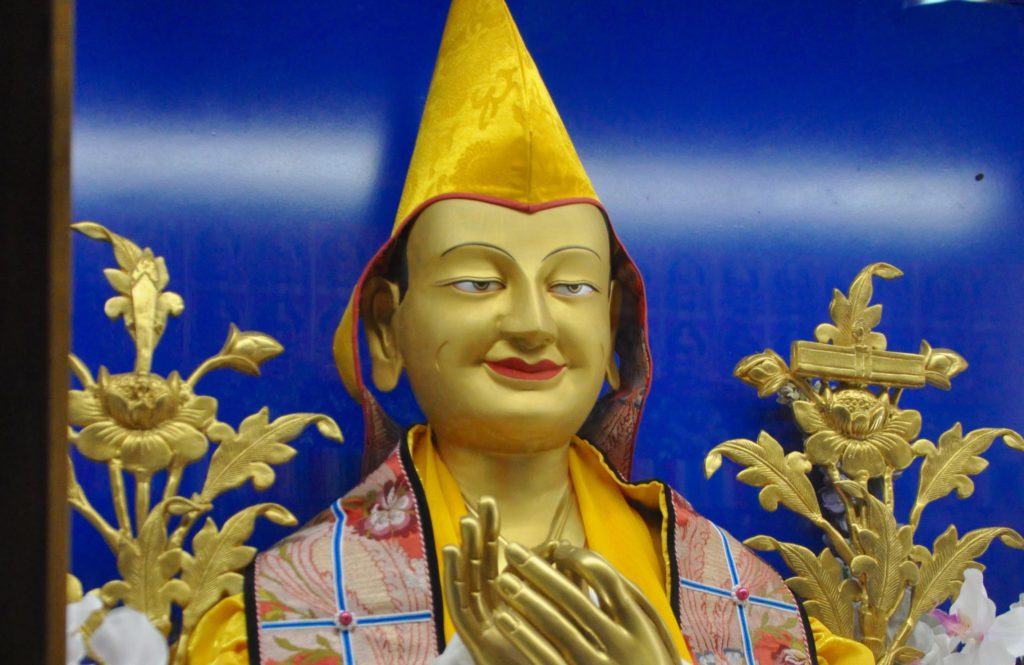
between two names for the new center: Lama
Tsong Khapa or Atisha. Since they practiced
the guru yoga of Lama Tsong Khapa, they chose
to call the center by his name. Lama Yeshe
also confirmed to them that he would have
wanted to call it by the name of Je Rinpoche
(i.e. Lama Tsong Khapa).
Lama
then said, “Okay. Let’s decide
together who will be responsible for the center
and who will do what work. I say Massimo as
director, Piero as spiritual director and
Claudio as secretary. What do you say?”
Then saying goodnight to Massimo, Piero and
Claudio he also told them the essence of the
significance of the center: “If the
center becomes a type of soup, a type of samsaric
game, then what would be the purpose of putting
energy into this project? Why should you,
why should I, put energy into it? We really
don't need to do that, don't you think? In
reality the true purpose of the center is
to give us the possibility to serve. We are
so lucky to have met the Mahayana dharma of
Lord Buddha and we have to try to share this
experience with others. Only for this purpose
should the center be founded. So, my dears,
okay. That's all, dears, for this evening.”
The address of the new Institute was originally
that of Massimo's house in Via Papiniano,
Milan, but in the summer of 1976 an apartment
was rented in Via Ampere in order to organize
the second course with the lamas. Piero and
Claudio initiated regular activities, inviting
Geshe Jampel Sangye and Geshe Rabten to give
courses. This second course took place October
5 - 24, 1976 in Taceno, a small valley between
Switerland and Lake Como, in an old hotel
that had been closed for more than two years.
With 24 hours of continuous work, several
students cleaned and prepared the place for
hosting the eighty participants, who came
from all over Europe. Rinpoche taught Lam
Rim and gave the 1000-Armed Chenrezig and
Tara initiations. Lama gave refuge, precepts
and the Vajrasattva initiation.
On the last day of the teaching, the students
met with Lama to discuss finding a stable
place for the Institute. Lama expressed very
clear ideas regarding what kind of center
should be established. He wanted it to be
in the country and to be composed of a community
of practicing students. It was to serve both
as a base for the organization of courses,
conferences and other activities that would
be useful for making dharma teachings known
to the public and as a center that would inspire
the practice of dharma in Italy. His idea
was that people living in the country far
from the busy city, through helping each other,
would progress more quickly in the practice
of dharma. In this way, they would become
an example and a guide to those interested
in the teachings.
Lama wanted the place to have space for monks
and nuns as well as single lay people and
families. He said, “We have to build
a mini-society in which these three types
of individuals who have always formed the
base for the spreading of the dharma in a
country are present. The ordained and the
lay people are to help each other in order
to be able to create a suitable support for
a Buddhist society. Ordained people alone
or lay people alone cannot work.”
During this meeting, the administrators of
the Institute agreed to work quickly to find
a place within the following year. On November
17, 1976, Istituto Lama Tzong Khapa was registered
as a cultural association, with Massimo Corona
as president; in January 1977, Massimo began
searching the length of Italy to find a suitable
place to establish a community. Geshe Rabten
suggested that Tuscany would be a good place
to check and after looking at many houses,
Massimo came to Pomaia. He immediately liked
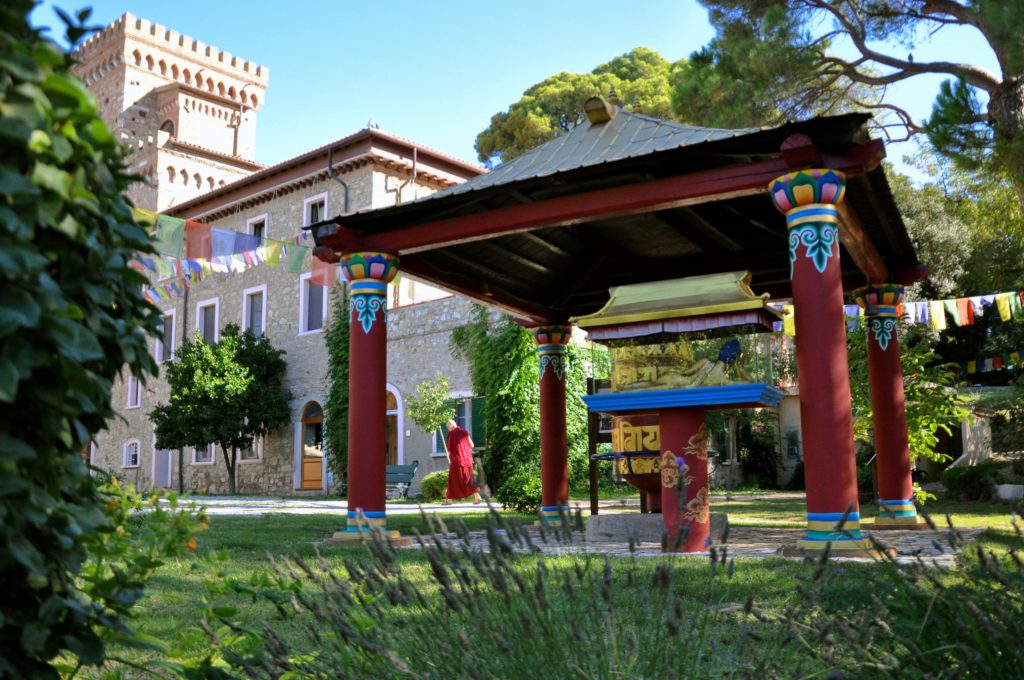
the large castle-style villa, set among the
trees on top of a small hill overlooking the
rolling countryside, and called Piero and
Claudio to say that he had found a really
beautiful house in the municipality of Santa
Luce (“Holy Light” in Italian).
Piero and Claudio traveled from Switzerland
to see the place and thought it was perfect.
They contacted Lama Yeshe, who gave his approval,
and the first contract was signed in April
1977.
In May 1977, Geshe Rabten and Gonsar Rinpoche,
after giving a course in Milan, came to Pomaia
to bless the site. On arriving there, Gonsar
Rinpoche pointed to the mountain behind the
Institute and said that it was very auspicious,
as its shape resembles that of an elephant.
In June, the first residents moved in, although
most of the building was still being rented
by the previous owner since it had not yet
been completely paid for. At that time, everyone
worked in the Institute and paid for their
own food and personal expenses. A gompa was
set up in a room that is now used as a second
dining room.
Lama Yeshe and Lama Zopa Rinpoche taught the
third Italian meditation course in Pomaia
that autumn and gave the community much-needed
advice concerning what was involved in establishing
a dharma center. Lama told them, “The
purpose of the center is to serve others.
This is an international center open to all
people of any race, nationality or background.
It is a place to learn how to train the mind
in order to liberate it from deeply rooted
harmful conceptions and thus to live in harmony
with others by integrating one’s meditation
practice in the work of everday life.”
In January 1978, the final contract with the
previous owner of the building was signed
and the community became completely dedicated
to dharma activities as well as to the restoration
of the main building and a house for resident
and visiting teachers. The small group of
residents worked hard, constructing a gompa,
dormitories, a kitchen and bathrooms. At that
time, a ruined building on the property was
transformed into a small comfortable house
(“the villetta”), with rooms upstairs
for the resident geshe and His Holiness the
Dalai Lama when he visited and a small apartment
downstairs that was previously used by Lama
Yeshe. This apartment is now used by Lama
Zopa Rinpoche when he visits and by other
visiting lamas and practitioners who want
to do retreat. The residents worked tirelessly
in the period before His Holiness’s
first visit in 1982 in order to finish a major
facelift to the exterior of the main building
in time for his arrival. |
|
|
|
|